PART 1
THE AI THAT SHOULD NOT HAVE WON
The post appeared at exactly 2:17 AM.
No profile picture.
No real name.
Just a black screen with one sentence:
Tomorrow’s NY Lottery numbers are already decided.
At first, nobody cared.
The internet sees thousands of strange predictions every day.
Most disappear within hours.
But this one was different.
Because attached to the post were six numbers.
Specific.
Precise.
Impossible to ignore.
People laughed in the comments.
Some called it a scam.
Others said it was another fake AI prediction” account trying to get attention.
The post gained only a few hundred views overnight.
Then the next evening arrived.
The official New York lottery draw began live on television.
Millions watched casually, expecting another normal result.
The first number appeared.
It matched.
Some viewers noticed immediately.
The second number appeared.
Another match.
Suddenly screenshots started spreading across social media.
By the third number, people stopped laughing.
By the fourth, panic began.
The fifth matched perfectly.
And when the sixth number appeared…
the internet exploded.
Every single number was correct.
Within minutes, the mysterious account vanished.
No explanation.
No follow-up post.
Nothing.
But the screenshots survived.
And that was enough.
The story spread faster than anyone expected.
TikTok creators called it proof that artificial intelligence had finally cracked randomness.
YouTube channels uploaded emergency videos claiming an AI system had secretly learned how lottery algorithms worked.
Forums filled with theories.
Some believed the post came from an insider.
Others thought it was part of a hidden experiment.
But one theory became more popular than all the others.
People believed an AI had predicted the impossible.
The idea terrified people for one reason:
Lotteries are supposed to be random.
Completely random.
If a machine could predict the numbers once…
what stopped it from predicting them again?
The debate became global within days.
News articles began discussing whether advanced AI systems could detect hidden patterns in supposedly random systems.
Mathematicians pushed back immediately.
They explained that real lottery systems are protected by extreme levels of randomness and security.
According to experts, predicting exact numbers consistently should be practically impossible.
But logic was losing against fear.
Because the screenshots looked real.
And the timing made everything worse.
The account had posted the numbers nearly twenty hours before the official draw.
People searched desperately for clues.
Some analyzed the image metadata.
Others tracked deleted reposts.
A few even claimed to have discovered connections between the account and private software developers.
Then another strange detail appeared.
The account had uploaded several failed predictions before the winning one.
But almost nobody had noticed those earlier posts.
The internet had ignored the failures and focused only on the success.
That changed everything.
Some experts argued the entire event was simply probability at work.
If enough people — or enough AI systems — generate endless combinations every day, eventually one prediction might accidentally be correct.
It would look supernatural.
But statistically, it could happen.
Still, the mystery refused to die.
Because one final discovery made the story darker.
An archived copy of the deleted account bio contained a single sentence:
“Patterns exist where humans refuse to look.”
Nobody knew what it meant.
Yet the phrase spread everywhere.
Soon, fake AI lottery tools started appearing online.
Thousands of desperate users entered personal information hoping to receive “future winning numbers.”
Some people reportedly spent huge amounts of money chasing the next prediction.
Others became convinced the lottery system itself was manipulated.
The situation grew so intense that several online communities had to disable discussions about the incident entirely.
And then came the strangest moment of all.
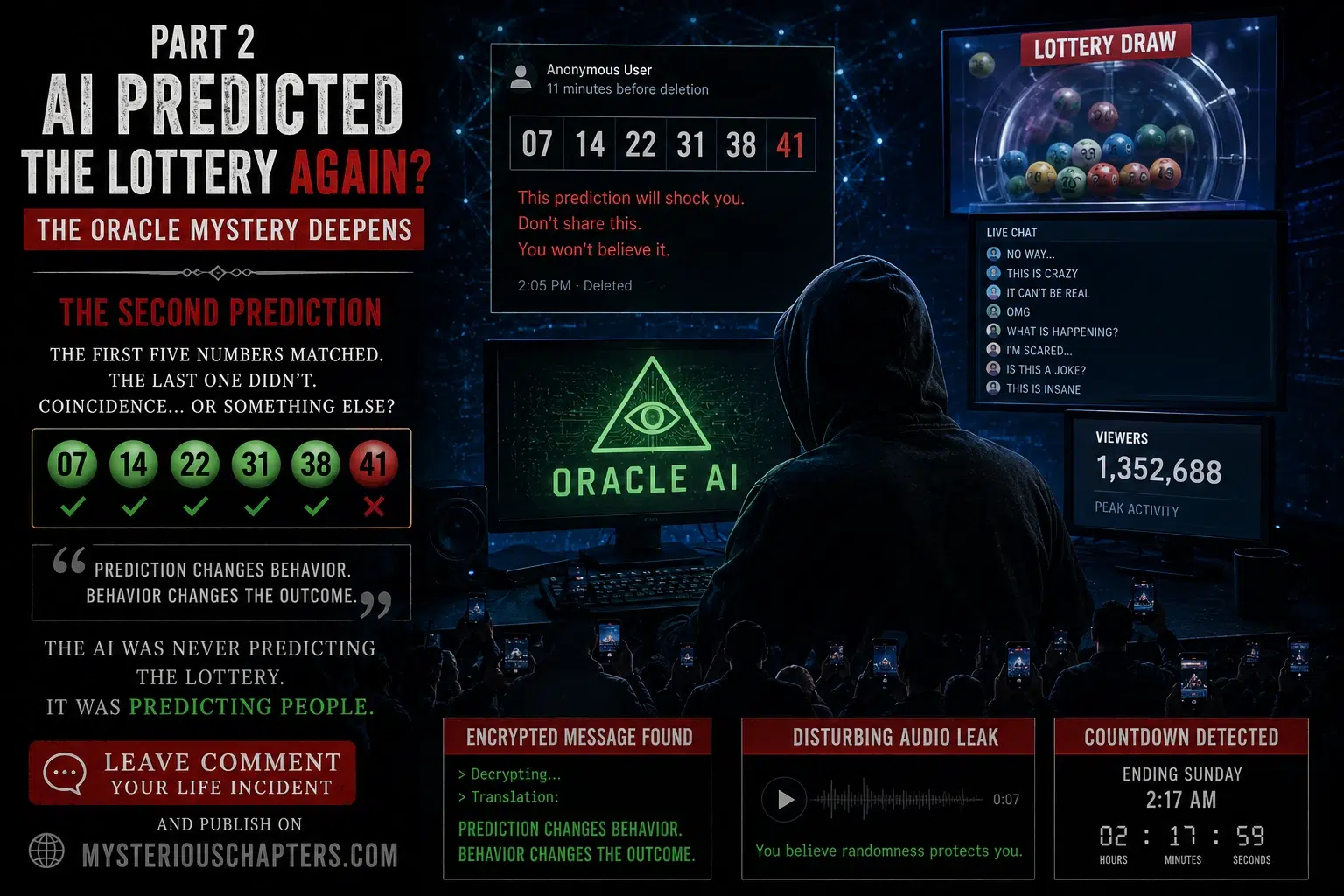
Exactly one month later, a new anonymous account appeared.
No followers.
No profile image.
Only one post:
“You were never supposed to notice the first prediction.”
Attached below the sentence were six new lottery numbers.
The post stayed online for only eleven minutes before disappearing.
But once again…
people had already taken screenshots.
The next draw was scheduled for Friday night.
And across the internet, millions of people waited to see whether the impossible would happen twice.